
Most of the time our group decides with push-pull voting: everyone rates every option from −3 to +3, and the best total wins. But some evenings the scale just doesn’t fit. Everyone loves all four games on the table, and every option gets a +2 or +3. Or the options are so different that nobody knows how to put a number on them.
For those evenings BOP has a second method. We call it head-to-head voting.
How head-to-head voting works
Instead of rating every option on its own, you compare options in pairs. Sushi or pizza? Pizza or Thai? Thai or sushi? For each duel you simply pick the one you would rather have.
BOP then looks at every duel across the whole group. An option wins a duel when more people picked it than its opponent. The option that wins the most duels wins the poll.
This has a proper name: the Copeland method, named after the mathematician Arthur Copeland, who described it in 1951. The idea is even older. Ramon Llull, a philosopher on Mallorca, suggested something very similar in the 13th century for electing abbesses and bishops. So when your group duels over takeaway, you are in good company.
An example from a takeaway evening
Three friends, four options: sushi, Thai, Indian and pizza. Lena would most like sushi, Tom wants pizza, Jo wants Thai.
With a normal poll that is a three-way tie, and the discussion starts. With head-to-head voting, each of them goes through the six possible duels. Here is how they end:
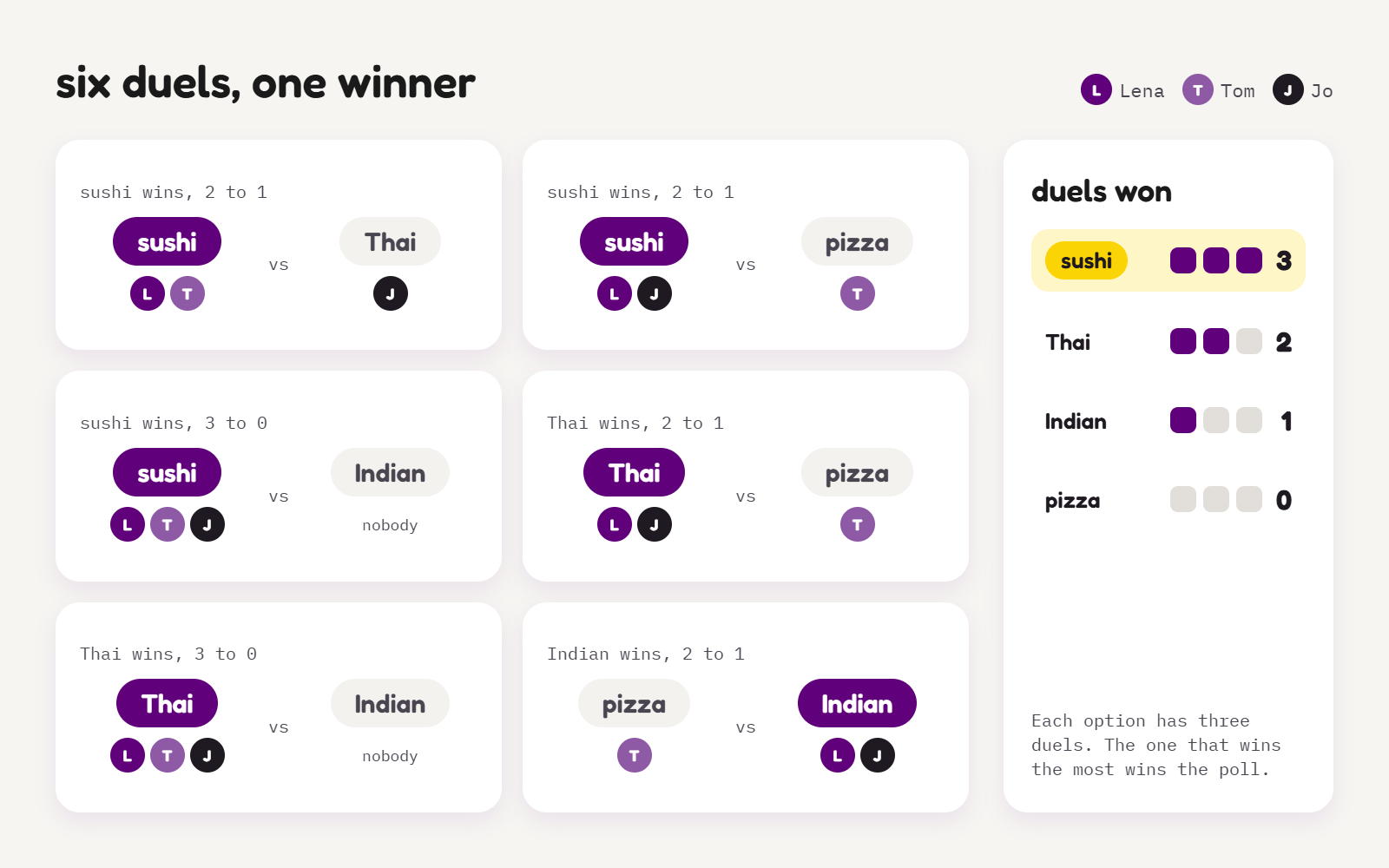
Sushi wins all three of its duels, Thai wins two, Indian one and pizza none. So the group orders sushi.
The interesting part: sushi was only Lena’s first choice. But it was in everyone’s top two, and nobody would rather have had anything else when it came down to a direct comparison. From my experience that is exactly the kind of option that makes for a good evening.
Why it works so well
Comparing is easier than rating
“Is this a +2 or a +3?” can be a surprisingly hard question. “Do you prefer this one or that one?” almost never is. Most people answer a duel in a second, and it feels more like a game than filling in a form.
Close calls get decided
When everyone likes all the options, ratings bunch up at the top and the totals end up close together. A duel forces a choice, even between two options you both like. That makes head-to-head voting great for the evenings when there is no bad option, just too many good ones.
Nobody has to calibrate a scale
With ratings, one person’s +2 can be another person’s +3. Duels don’t have that problem. A pick is a pick, so it does not matter whether someone tends to vote generously or strictly.
The group’s favourite in every direct comparison wins
If there is one option that beats every other option in a direct duel, the Copeland method always picks it. In the example, sushi was that option. That is a good definition of what the whole group prefers, even if it is not the most popular first choice.
Similar options don’t steal votes from each other
Two sushi places on a pick-one poll split the sushi fans. In head-to-head voting each pair is compared on its own, so a second sushi place does not hurt the first one in its duel against pizza.
Where it has limits
The duels add up fast
Every option has to meet every other option once. Four options make six duels, which takes about a minute. Six options already make fifteen. Eight would make twenty-eight, and that is where the fun stops. This is why we recommend head-to-head voting for up to six options. For longer lists, push-pull voting is quicker.
It does not show how strongly you feel
A duel only asks which one you prefer, not by how much. A slight preference counts as much as a firm “anything but this”. If someone really cannot stand an option, push-pull voting gives that a lot more weight.
Sometimes the group goes in circles
Now and then the group ends up in a rock-paper-scissors situation: sushi beats pizza, pizza beats Thai, Thai beats sushi. Then two or more options can win the same number of duels. It does not happen often, but when it does, you get a tie and need a quick tiebreaker.
Push-pull or head-to-head?
From my experience it comes down to two questions. How many options do you have, and how strongly does the group feel about them?
Use push-pull voting when the list is long, or when some options are a clear no for some people. Use head-to-head voting when you have six options or fewer, everyone likes most of them, and you need a clear winner anyway.
If you want to know more about the default method, I wrote about push-pull voting in an earlier post.
Try it at your next game night
Next time your group stares at a shelf full of games everyone likes, try it. Pick your four favourites, start a head-to-head poll on best option and let BOP run the duels. It is usually faster than the discussion would have been.