
Picture a group of five friends trying to decide where to eat on Friday. Someone suggests sushi in the group chat and three people answer right away with a lot of enthusiasm. The other two don’t say anything, and as usually happens, everyone takes that as a yes. So sushi it is, three to two.
I’ve been at that dinner more than once, and from my experience it tends to go the same way. Three people have a lovely evening. The other two share a bowl of edamame and stay polite about it, and one of them heads home a bit early because of something they supposedly have to do the next morning.
What I find interesting is that nobody did anything wrong here. The vote was fair and the majority got what it wanted. I just think it was the wrong kind of vote for a dinner among friends, and I’d like to explain why I’ve come to believe that the option the fewest people hate is usually a better choice than the option the most people love.
What a majority vote doesn’t ask
When you ask for a show of hands, each person gets to tell you one thing, which is their favorite. You don’t find out how much they like it or how they feel about the other options, and you certainly don’t find out whether there’s something on the list they really can’t stand.
That means the friend who thinks “sushi would be nice, but I’d be just as happy with tacos” counts exactly as much as the friend who would honestly prefer to skip dinner altogether. The first one gives up very little if sushi loses, while the second one gives up most of their evening if it wins. A simple count can’t tell those two apart.
For a lot of decisions that’s perfectly fine. For an evening with people you want to keep seeing, I think it leaves out the part that matters most.
One unhappy person changes the whole table
If you’ve ever played D&D, you know that the party travels at the speed of its slowest member. In my experience, evenings with friends work in a similar way.
Three people enjoying their food don’t make the table three times as fun as one person would. One person picking at a cucumber roll, on the other hand, is something everyone notices sooner or later. Somebody starts trying extra hard to cheer them up, the conversation gets a little more careful, and the mood of the whole group shifts. As a host, I tend to remember the one guest who wasn’t having a good time far longer than the ones who were.
So imagine the same five friends could rate each option instead of just picking one. Let’s say −3 stands for “I’d rather not eat”, 0 for “I don’t mind either way” and +3 for “yes, absolutely”.
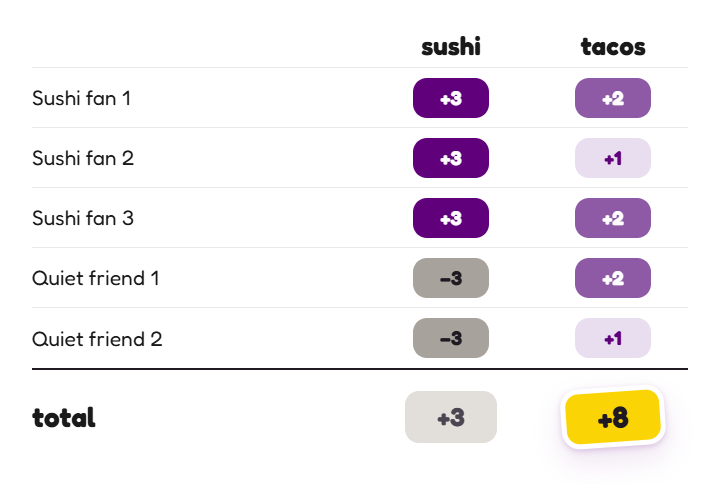
Tacos aren’t anybody’s first choice here, and they still come out well ahead, because nobody at the table minds them and a few people quite like them. Everyone gets a decent evening out of it, which is more than you can say for the sushi plan.
This is why the scale in best option runs from −3 to +3 and not from one to five stars. We wanted the dislikes to count as much as the likes, because they often tell you more about how the evening will go.
Doesn’t that lead to boring choices?
That’s the obvious objection, and I think it’s a fair one. If the least hated option always wins, it’s easy to imagine a group that ends up with pizza margherita and the same two board games for the rest of its days.
I don’t think that’s what happens, though, and the taco example shows why. Tacos didn’t win because nobody had an opinion about them. They won because nobody objected and most people were somewhere between mildly and quite happy with the idea. A truly boring option would get a row of zeros, whereas a good compromise gets small positive scores from almost everyone, and those evenings tend to turn out better than they sound on paper.
If your group does keep landing on the same safe choice, I’d look at the list of options before blaming the method. Usually it means nobody has suggested anything new in a while.
It also helps that there is room between the extremes. “Not really my thing” is a −1, while “I’m vegetarian” or “my ex works there” is a −3, and most people are quite good at telling the difference. There is always one friend who gives a −3 to anything they didn’t suggest themselves, but that’s a subject for a different post.
When the favorite should win anyway
I wrote “most of the time” in the title because there are situations where I’d throw all of this out without hesitation.
The clearest one is when the occasion belongs to somebody. If it’s a wedding, a birthday or a farewell dinner and the person being celebrated wants sushi, then there will be sushi, and those of us who don’t care for it can eat our edamame and be happy for them. The evening was never about our dinner in the first place.
The second one is when not everybody has to come along. Not every plan needs the whole group, and if three friends are really excited about the new sushi place, they can simply go on a Tuesday while all five do something else on Friday. I know the rule says never to split the party, but I’d argue that one was meant for dungeons.
The third is a bit harder to spot. Sometimes the same person ends up going along with the compromise again and again, and what looks like consensus is really one friend giving in every time. When I notice that in my own group, I try to make sure that person gets to choose next, even if their pick wouldn’t win a vote. Over a year of Fridays, that seems fairer to me than getting each single evening exactly right.
Something to try this Friday
You don’t need any special tool to try this out. The next time your group is deciding on something, ask whether there’s anything on the list that someone would really dislike before you ask what everybody wants. Take those options off, and then choose from what’s left in whatever way you normally would.
From my experience, that one extra question is often enough to hear from the friends who usually stay quiet, and the more vocal ones still end up with something they like. With a bit of luck, nobody will need an excuse to leave early.