
For a long time, game night meant Frosthaven. Nobody had to ask what we would play. The only thing to figure out was which scenario came next. Recently we decided it was time for something different, and suddenly there it was again, the question we had been spared for ages: so, what do we play next?
From my experience, this is a delicate moment for a gaming group. You are choosing the thing you will spend the next months with, and nobody wants to be the one who talked everyone into forty hours of a game that turns out to be a dud.
Some context on us. We are three players, we enjoy cooperative games as much as competitive ones, and we meet on normal weekday evenings, so a session has to end before anyone falls asleep on the rulebook. We wanted something that stays on the table for a while, with a story that runs over several evenings or with mechanics that are still giving us new ideas on night five.
In case your group is facing the same Frosthaven-shaped hole in the calendar, I have written down all fourteen games we looked at, including the numbers we cared about and the reasons each one might not be right for you.
How we got from fourteen games to one
It started the way these things usually start, with everyone throwing names into the group. We did not filter anything at that point and ended up with fourteen candidates.
Then we collected the facts for each game in one overview. How does it play with three? How long is a session, and how long is the whole campaign? How heavy are the rules, and what does it cost? I found this part more useful than expected. A game can sound perfect in a two-minute pitch and still lose most of its charm once “200 to 300 hours” stands next to it.
For the decision itself we set up a best option with all fourteen games, and each of us voted alone, without knowing what the others thought. Since everybody rated every game, we could see which one all three of us would be glad to play.
Arcs came out on top, together with its Blighted Reach campaign. It was a close race, though, with ISS Vanguard and Dead Cells only just behind.
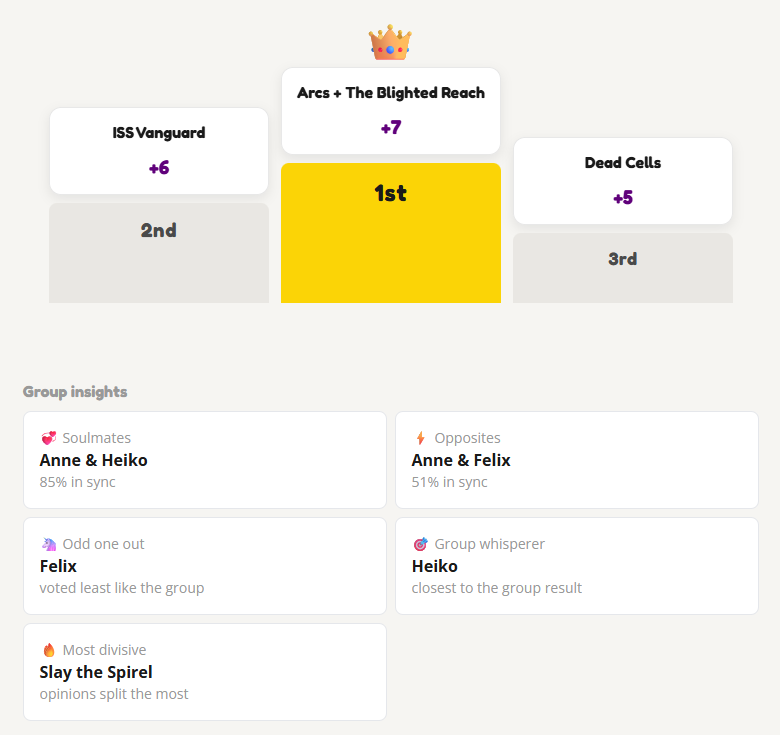
The three that ended up on top
A word on the numbers in this post. Complexity is the BoardGameGeek weight, from 1 for light to 5 for brain-melting. Prices are rough German street prices, and campaign lengths are estimates, so please read them as a direction.
Arcs with the Blighted Reach campaign (our winner)
Competitive · 2 to 4 players, best with 3 · 3 to 4 hours per session · 8 to 10 hours in total · complexity 3.4 · 145 to 170 € for base game and campaign
Cole Wehrle’s space opera is full of betrayal and shaky alliances, and it runs on a trick-taking system, of all things. In the campaign, each player follows an asymmetric fate that changes over three acts, so the whole story fits into three evenings. There are 24 fates to combine, which means you can start again and play a very different game.
I think it suits a group like ours because it is a change of direction. After a long cooperative campaign, playing against each other feels fresh, and three evenings is a commitment nobody has to be afraid of.
Be warned that Arcs is not a kind game. There is plenty of take-that, and dice and cards will ruin your plans now and then. The campaign adds a good layer of rules on top of the base game, and one act keeps you busy for three to four hours.
ISS Vanguard
Cooperative · 1 to 4 players · 90 to 180 minutes per session · 60 to 100 hours in total (30 to 40 sessions) · complexity 3.7 · 135 to 170 €
This is the candidate for everyone who wants another big cooperative campaign and has seen enough dungeons for now. ISS Vanguard feels a lot like Star Trek. Each player runs one section of the ship, you land on planets and explore them with dice, and back on board you research, build and recruit. The ship phase comes with actual binders full of things to unlock, and if you liked putting stickers on the Frosthaven map, you will probably love it.
It asks a lot in return. Learning it takes a while, so does setting it up, and the dice decide more during exploration than some players like. With 30 to 40 sessions it is also the second-longest campaign on this list.
Dead Cells: The Rogue-Lite Board Game
Cooperative · 1 to 4 players, best with 3 · 30 to 60 minutes per run · 12 to 20 hours in total (15 to 25 runs) · complexity 2.3 · 75 to 90 €
Dead Cells is the opposite of Frosthaven in almost every way. Setup takes five minutes and a run about 45, so “one more run” is a realistic thing to say at ten in the evening. You still make real progress, because the cells you collect flow into permanent unlocks. Nothing is destroyed along the way, and you can reset the whole box.
It is not a story game, and card luck makes some runs much easier than others. One detail made it interesting for three players: at four, somebody sits out in every fight, and at three nobody does.
More cooperative campaigns with a story
The next five are all cooperative story campaigns that you can reset and play again. Where they differ is in how much time, table space and patience they want from you.
Sleeping Gods: Distant Skies
1 to 4 players · 60 to 240 minutes per session · about 15 hours in total · complexity 2.9 · 105 to 120 €
Sleeping Gods: Distant Skies on BoardGameGeek
Think of an open world in a box, with an atlas to travel through, a storybook and more than 350 adventure and quest cards. You can save whenever you like, which makes it very friendly to weekday evenings, and you do not need to know the first Sleeping Gods. Most players recommend it for one or two people, though. At three or four there is a lot of reading aloud, and the hand limit starts to pinch.
Earthborne Rangers
1 to 4 players · 90 to 120 minutes per session · 30 to 40 hours in total · complexity 3.5 · 87 to 99 €
Earthborne Rangers on BoardGameGeek
Earthborne Rangers is a card game set in an open valley that you explore day by day. You are more likely to calm a creature than to fight it, you pick your own stories, and your deck grows with your character. The solarpunk setting is unlike anything else here. It is a slow game by design, and that cuts both ways. If your group lives for a good boss fight, some evenings will feel like a long hike, with a fair amount of text and campaign log on top.
Tainted Grail: Kings of Ruin
1 to 4 players · 90 to 180 minutes per session · 30 to 50 hours in total (8 to 10 chapters) · complexity 3.3 · 110 to 130 €
Tainted Grail: Kings of Ruin on BoardGameGeek
For groups that care more about the plot than about tactics. Kings of Ruin is a dark take on the Arthurian legends in which you explore, negotiate and make decisions that really change the story. The price is reading time, and plenty of it, especially when three or four people share one story. Combat works more like a puzzle than a battle. One practical problem is that the German edition rarely shows up in shops.
The Elder Scrolls: Betrayal of the Second Era
1 to 4 players · 2 to 4 hours per session · 12 to 15 hours per campaign · complexity 4.1 · around 240 €
The Elder Scrolls: Betrayal of the Second Era on BoardGameGeek
From the team behind Too Many Bones comes a tactical dungeon crawler with dice, chips and very deep character building. What I find clever is the structure. There is no 100-hour story to commit to. A campaign takes 12 to 15 hours, and then you start another one with new characters in a different region. You pay for it with a steep learning curve, long sessions and the second-highest price on this list.
Aeon Trespass: Odyssey
1 to 4 players · 2 to 4 hours per session · 200 to 300 hours in total (3 cycles) · complexity 4.8 · 300 to 400 €
Aeon Trespass: Odyssey on BoardGameGeek
Everything about this one is huge. You fight titans with titans of your own, and yours get stronger the more they are wounded. Around that there is ship management and a story that mixes Greek mythology with science fiction. Its boss fights are often called the best in the genre. On the other side of the scale you have 200 to 300 hours, an enormous amount of rules and text, English only, and a price that could buy you three other games from this post. I would only start it with a very reliable group.
Three real legacy games
Legacy games change for good while you play them. You put stickers on the board, tear up cards and open sealed boxes when the story tells you to.
Pandemic Legacy: Season 1 (or Season 0)
Cooperative · 2 to 4 players · 45 to 75 minutes per session · 15 to 25 hours in total (12 to 24 games) · complexity 2.8 · 60 to 75 €
Pandemic Legacy: Season 1 on BoardGameGeek
The classic of the genre, and after ten years still near the very top of the BoardGameGeek ranking. The campaign plays like a thriller over twelve in-game months, a session takes about an hour, and nobody has to study a 200-page rulebook first. No other game on this list fits a normal evening as easily. Coming from Frosthaven, you will find it tactically lighter, and when the campaign ends, the game is used up. Season 0 has a Cold War setting and is a little more complex.
Clank! Legacy: Acquisitions Incorporated
Competitive · 2 to 4 players, best with 4 · 90 to 120 minutes per session · 18 to 24 hours in total (10 to 12 games) · complexity 2.7 · around 125 €
Clank! Legacy: Acquisitions Incorporated on BoardGameGeek
The most light-hearted game of the fourteen. Underneath it is easy deck building and a race through a dungeon, and on top sits a campaign book with side quests and decisions that change the world permanently. When the campaign is over you own a one-of-a-kind copy of Clank! that stays fully playable, so the usual legacy worry does not apply. You can explain it to guests in a few minutes. It remains a light game with a good portion of luck, and the price is steep for that.
The Queen’s Dilemma
Competitive · 3 to 6 players · 60 to 90 minutes per session · 30 to 35 hours in total (15 sessions) · complexity 2.9 · around 140 €
The Queen’s Dilemma on BoardGameGeek
Each player leads a house in the royal council, and every vote changes the kingdom permanently. It is all negotiation and intrigue, in sessions of 60 to 90 minutes, and a recharge pack lets you play a second campaign. For a table of three it is a risky pick, because three is the minimum and a game that depends on people arguing gets better with five or six. It is also brand new, so hardly anyone can tell you yet how it holds up over fifteen sessions.
No campaign, still plenty to dive into
The last three have no campaign. They are on the list for the other half of our wish, games you can play five or ten times and still find something new. All of them are cooperative.
The Lord of the Rings: Fate of the Fellowship
1 to 5 players, best with 3 · 60 to 150 minutes · complexity 3.0 · 60 to 70 €
The Lord of the Rings: Fate of the Fellowship on BoardGameGeek
Matt Leacock has taken his Pandemic system further here than ever before. You finish a game in one evening, there is nothing to track between sessions, and you still get proper story moments, like sneaking Frodo past the Nazgûl. With thirteen characters and 24 objectives, it does not repeat itself quickly. Your characters do not grow from game to game, however, and like every cooperative puzzle it invites one player to tell everyone else what to do.
Slay the Spire: The Board Game
1 to 4 players · 2 to 3 hours per run · complexity 2.9 · 113 to 120 €
Slay the Spire: The Board Game on BoardGameGeek
If you know the video game, you know what to expect: cooperative deck building in self-contained runs, with card combos to chase and bosses to beat. A run takes two to three hours and you can save between acts, so every evening stands on its own. The adaptation is excellent. It has no story and nothing carries over, runs get longer with every extra player, and you will need a big table.
Vantage
1 to 6 players · 2 to 3 hours · complexity 2.3 · 83 to 90 €
Vantage is an open-world adventure for a single evening. Groups tend to keep coming back anyway, because you understand the planet a little better each time. Every player sees the world from a different place, and there are more than 800 locations to find. Nothing has to be remembered between sessions, which makes it the most forgiving choice when someone cannot make it. The rules are light, the dice have a lot to say, and you do not build anything lasting.
If you are standing in front of the same shelf
I would not simply take over our result, since your group will want different things. A table of three or four that is hungry for another long cooperative campaign will probably end up with ISS Vanguard. If you can only promise each other an hour at a time, Pandemic Legacy or Dead Cells will serve you well.
The process is worth copying, though. Let everyone suggest games, write the facts down next to each other, and have everybody vote alone before the discussion starts. In our case a few games quietly dropped out the moment campaign length and price stood next to the title. And the vote saved us the evening in which three polite people try to guess what the other two really want.
Feel free to take the fourteen games above as your starting list, throw out what does not fit and add your own candidates.
Arcs is next on our table. I will report back on how well our friendships hold up in a game that rewards betrayal.